

My T-Shirt Memory Quilt (cont.)
Part 2: Prep Work

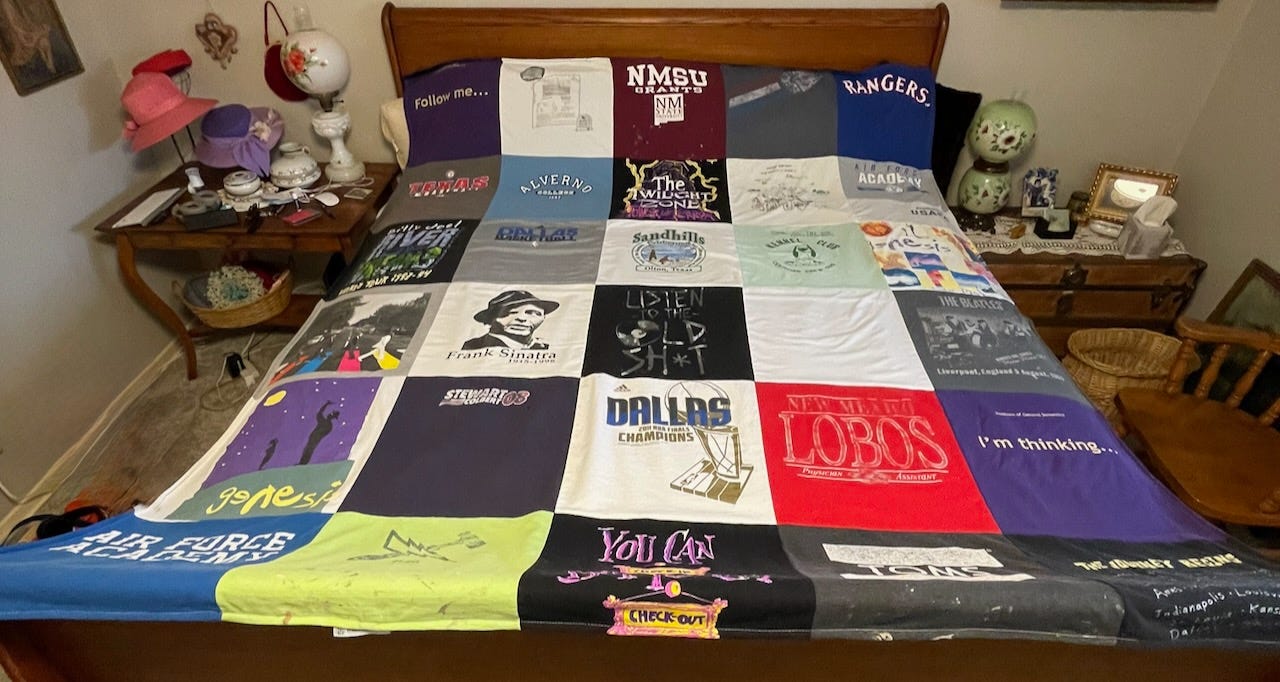
In case you missed it, here’s Part 1: I Forgot My Memory Quilt. For anyone who’s intrigued with the idea of a quilt stitched with old T-shirts, you might find the following of interest.
This process describes what I did four years ago to create my quilt with memorystitch based in Omaha, Nebraska. This may or may not be current or applicable now. Other vendors may well be worth considering. I did not.
Preparing A Memory Quilt
The Easy (Alternative) Way
Select the T-shirts you wish to sacrifice for the greater purpose.
Do this:
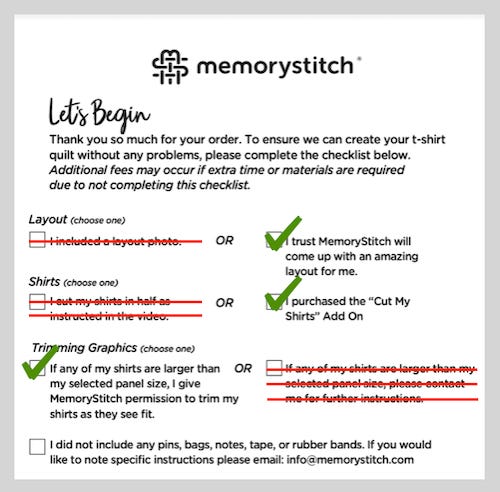
The Easy Way: All you have to do is choose the shirts, pack ‘em up and ship ‘em out. Enclose the order with the volunteered T’s and ship them off. You’re done.
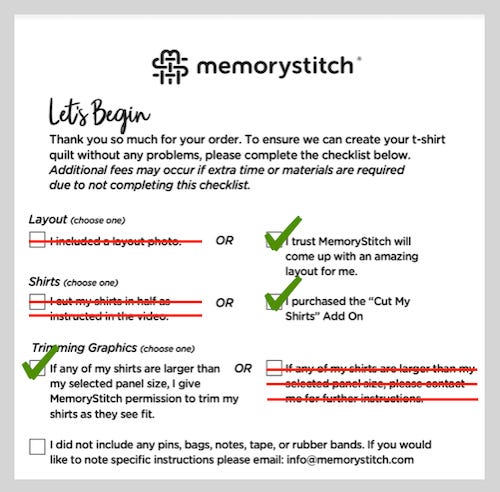
My Way – Six Steps
Selected the shirts.
Measured the graphic or text part of each shirt to verify sizing.
Arranged the shirts on a grid as desired (using photos, not the actual shirts).
Took a photo of the grid to enclose with the order to ensure proper arrangement.
Cut the shirts in half as explained in the instructions.
Shipped the shirts at my expense.
My Way – Implementation
Disclaimer: In retrospect – four years after the fact – I have to admit this is pretty control-freaky embarrassing.
Shirt Selection
I selected a few more shirts than needed, but … just in case.
Measurement
I cut out an L-shaped, slightly-over-an-inch wide square ruler out of cardboard to provide a ‘frame’ for each panel to approximate the overall overage required for each panel.
I ‘framed’ the two-sided ruler on top of each shirt to check the sizing for any shirts that might cause issues from either being too large or that were too close to the collar (approimately two inches).
Note that I only cut one ruler, not one for each panel. The usage of the ruler is to align it such that the outside edges of the frame enclose what I would want to be seen on the quilt, after folding and stitching; anything more than that is fine.
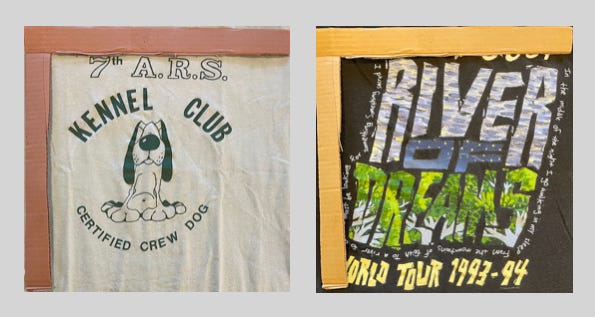
For example, if the “River of Dreams” image would’ve been large enough to force the “World Tour 1993-1994” down below the bottom of the vertical frame, I would’ve had to consider replacing that shirt with another.
For each of the 30 shirts I used the square ruler to verify the image sizing, then photographed each individual shirt.
Arrangement and Photo
With some assurance that my chosen shirts would work, I moved on to the arrangement in the 6-row, 5-column grid.
For the arrangement, I cropped each of the photos to the same sized square. Using Photoshop I made my first pass at arrangement the shirt panels in the grid. By the third pass I was satisfied.
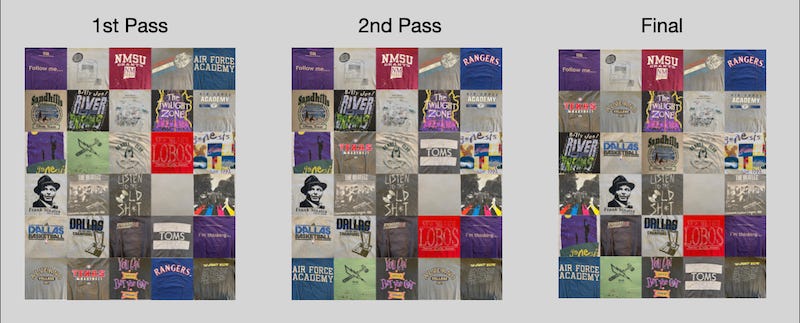
Now I was ready to rip and cut my treasured T’s in halves, per the instructions.
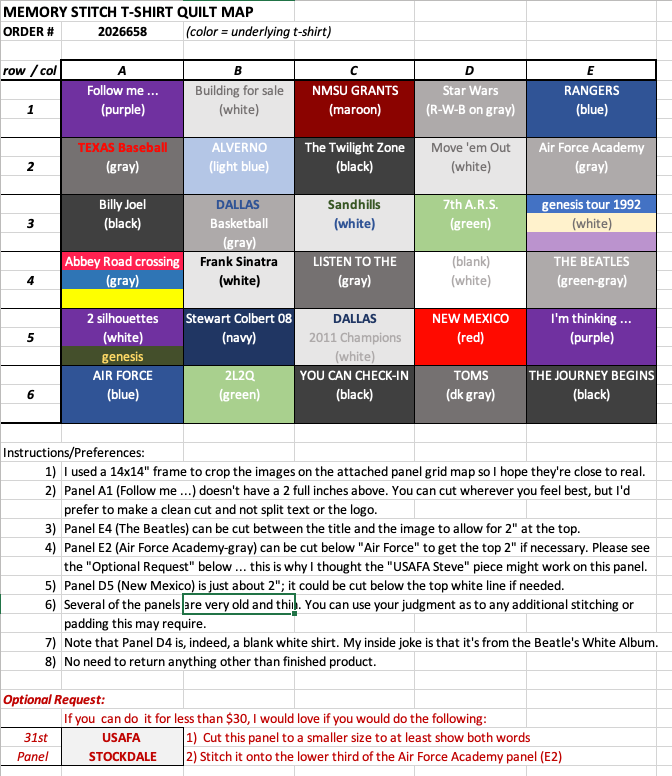
But even after that I wasn’t through. Simply providing one visual ‘map’ of my quilt to the vendor wasn’t enough to leave absolutely no room for doubt as to my desires.
The vendor had their order instructions; I had mine. I’m not proud of it, but I actually sent this in with my bundle of T-shirts.
My Experience Four Years On
I was pleased with the vendor and the outcome, especially the cost, which with a 40%-off after-Thanksgiving sale was only $112 for the king-size quilt.
I purchased the idea of the quilt, I think, moreso than the quilt itself. By that I mean after five decades, I had kept all these T-shirts because they meant something to me over and above their torso-covering functionality. I really bought into the story-telling or memory-remembering aspect of the T-shirt quilt; not so much to use it, but to have it. And then, realistically, to leave it.
These past few days of remembering-I-had-forgotten I had the quilt caused me to re-think what the purpose of having it was, or will be. Since receiving it four years ago, I’ve only unfolded it fully four or five times. Not until Tuesday night did I ever actually make my bed to accommodate using it. It’s too big for my bed. After I write the stories that I wanted to remember … I’m not sure what I’ll do. Maybe folding it up and storing it is as good a solution as any.
All in all, I’m glad I did it and that I have the quilt. I’d recommend it worthy of consideration.
Next up: In Part 3 I’ll begin to recount the stories wrapped in the shirts. You might consider following or subscribing to my “Lived Stories” no-charge publication.
Steve, I totally understand these steps you took to get your shirts ready for assembly. Your diagrams are so helpful. It gives me the motivation to start pulling out my own t-shirts and making choices. The cardboard guide ruler is a good idea for actually seeing the content framed as it would be in finished form. I look forward to hearing your stories. Thank you for posting this!